Industrial Application Knowledge Base
Eight industry application pages for the JY-N95 automatic centrifugal separator, each with contaminant analysis, process flow and engineering FAQ.
How to read these application pages
Eight industry applications where automatic centrifugal separation is used to control fine solids in process fluids. Each page covers the contamination mechanism, the limits of conventional filtration, the process flow, and the data our engineers need before confirming suitability.
Three feed characteristics decide most duties: solids fine enough to settle within one pass — single-digit microns and above, or made separable by flocculant dosing ahead of the separator — a solid–liquid density difference of about 0.1 g/cm³ or more, and a solids load between roughly 1 % and 50 % by weight. See the full material characteristics.
Start with the constraint, not the machine
The selection centre runs the same six checks our engineers run — flow range, chemistry, settling behaviour, viscosity and temperature, pretreatment, and the resulting classification.
Eight Detailed Industry Applications
Each page follows the same structure: industrial challenges, contaminant analysis, separation technology and its boundaries, process flow, confirmed parameters, selection entry and FAQ.
Tungsten Carbide & Precision Grinding
Centrifugal separation for cemented-carbide grinding coolant: removes non-magnetic carbide and abrasive fines by density, without filter media.
Aluminium Extrusion & Metal Forming Oil
Centrifugal separation for aluminium extrusion lubricant and cold-heading oil: removes fine aluminium, phosphate scale and sludge without filter media.
Waste Oil Regeneration
Centrifugal front-end separation for waste-oil regeneration: removes heavy solids and sludge before membrane and distillation stages.
Optical Glass & Technical Ceramics
Centrifugal separation of optical glass and technical-ceramic grinding fluid: removes fine non-magnetic powder and abrasive without filter media.
Wire Drawing & Metal Processing
Centrifugal separation for wire and tube drawing lubricant: removes copper, aluminium and steel fines by density, without filter media consumption.
Industrial Paint Sludge Separation
Centrifugal compaction of paint sludge from water-curtain spray booths: reduces sludge volume for disposal and returns clearer water to the booth.
Industrial Cleaning & Surface Treatment
Bypass centrifugal purification for cleaning and pretreatment baths: removes sludge and suspended solids while the bath stays in service (confirmed pH 6–9).
Gear Honing & Powder Metallurgy
Centrifugal separation for gear honing, cutting and quench oils, and powder-metallurgy circuits: fine metal and abrasive solids removed without filter media.
JY-N95 in a Circulation Loop
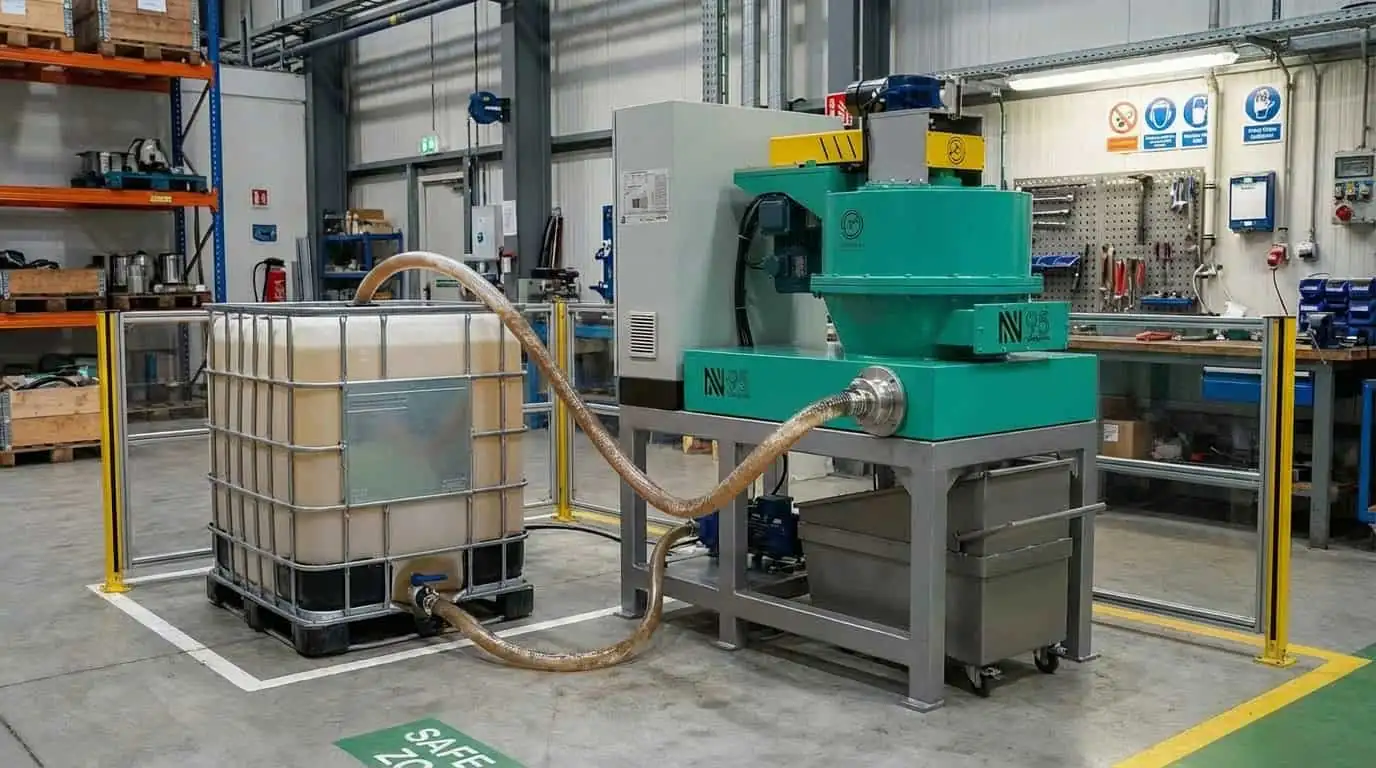
How these pages are meant to be used
Read the industry page closest to your process, check the contaminant analysis against your own fluid samples, then run the selection check. If your process sits between two directions, the evaluation path is the same: send the fluid and process data and our engineers review it.
Every page states its technical boundaries. Where a question needs test evidence we do not have, the page says so instead of quoting a number.
Not Sure Which Direction Fits?
Send your fluid type and separation objective — our team maps it to the right evaluation path.