
Industrial Paint Sludge Separation & Dewatering
Water-curtain spray booths capture overspray in circulating water, where it forms a sticky sludge that loads the tank, fouls the plant and generates a large volume of hazardous waste. Centrifugal compaction reduces that volume and returns clearer water to the booth.
This page covers one application direction in detail: where the contamination comes from, what the fluid and solids actually are, how centrifugal separation behaves in that context, and what has to be confirmed before a machine is specified.
In short
- The duty is volume reduction: compacting paint, detackifier and pigment sludge so less water leaves the plant as hazardous waste.
- Sludge denser than water is compacted at the bowl wall; sludge lighter than water behaves differently and is evaluated individually.
- The JY-N95 covers 25–120 L/min with 2200 G rated acceleration and automatic solids discharge; the confirmed pH range is 6–9.
- No compaction percentage is published, and separation does not change the waste classification of the cake.
What Makes This Application Difficult
Where the contamination comes from
- Overspray paint, solvent and detackifier chemistry combine into a sludge that floats, sinks or stays dispersed depending on the paint system.
- Sludge accumulates in the tank, in the piping and on the booth walls, reducing effective water volume.
- Solids carry solvent and paint chemistry, which affects how they can be handled and classified.
Fluid characteristics
- Booth water is a chemically treated circuit: detackifiers, pH adjusters and biocides change the behaviour of both the water and the sludge.
- Paint systems differ widely — solvent-borne, water-borne, powder and two-component — and each produces a different sludge structure.
Where conventional filtration falls short
- Manual skimming and digging-out is labour-intensive and exposes operators to chemicals.
- Filter media and screens blind quickly on sticky sludge and consume a large volume of disposable material.
- Uncompacted sludge is mostly water, so disposal cost is dominated by water that did not need to be transported.
Effect on production
- High sludge volume means high hazardous-waste transport and disposal cost.
- Solids in circulation damage pumps, nozzles and the water curtain, and reduce booth efficiency.
- Cleaning shutdowns interrupt painting production and are difficult to schedule.
Solids, Fluid and Operating Conditions
Qualitative characterisation — the actual range for your process is established from fluid samples and operating data, not assumed from this table.
| Particle / solid | Density difference | Typical size | Solid concentration | Fluid viscosity | Temperature & chemistry |
|---|---|---|---|---|---|
| Paint overspray solids | Low to moderate; detackified sludge varies | Flocculated, variable | High in the booth sump | Water-like with flocs | Solvent-bearing; pH and detackifier dependent |
| Detackifier and treatment sludge | Moderate | Flocculated | Continuous addition | Water-like | Alkaline or acidic depending on system |
| Pigment and filler particles | Moderate to high (inorganic pigments) | Finer than 1 µm to micron | Paint-dependent | Water-like | May contain heavy metals depending on the coating |
Density difference, size class and loading vary by process. Absolute values are confirmed during application evaluation.
Water-Borne, Solvent-Borne and Two-Component Booths
Paint systems produce different sludge. The first evaluation question is whether the sludge sinks, floats or stays dispersed.
| Aspect | Water-borne paint | Solvent-borne paint | Two-component and reactive systems |
|---|---|---|---|
| Sludge character | Often finer and more dispersed; can stay suspended in the booth water | Tacky; can float or sink depending on the detackifier programme | Reactive resin can harden into deposits in the tank and piping if left |
| Solvent and safety | Lower solvent load, but not zero | Flammable solvent vapour is possible; area classification and explosion protection are reviewed per project | Depends on the formulation; reviewed per project |
| Chemistry | Detackifier, pH adjusters and biocides set the floc condition | Detackifier programme sets whether the sludge sinks or floats | Reaction time matters; sludge is removed before it cures |
| Evaluation emphasis | Floc strength, fine pigment, dry-solids content of the feed | Sludge density (sink or float), solvent content, floc condition | Cure timing, deposit location, floc condition |
| Waste | Classified by analysis of the actual sludge | Classified by analysis; solvent content matters | Classified by analysis of the actual sludge |
Qualitative comparison. Sludge from your own booth replaces this table at evaluation.
How Centrifugal Separation Applies
Paint sludge behaves differently from mineral solids: much of it is low in density and chemically sticky, so it does not settle cleanly in a tank. A centrifugal field compacts the floc against the bowl wall, driving out free water and producing a denser cake than skimming or settling can achieve. The bowl geometry and discharge cycle are configured for the sludge actually produced by the booth.
The economic argument is volume reduction: the same mass of paint solids leaves the plant in a smaller, drier package, and the water that is pressed out stays in the booth circuit instead of being transported away as hazardous waste. Whether the cake meets a given disposal route's criteria depends on the paint chemistry and on local regulation, and is confirmed by analysis of the actual sludge.
Fit is decided in this order: whether the sludge sinks or floats, the floc condition, the feed solids concentration, then throughput. The next section sets out how those variables act on compaction.
- Paint systems vary widely. Sludge from different coatings behaves differently, and the achievable compaction must be tested on the actual booth sludge.
- The cake remains hazardous waste unless the paint chemistry and local rules say otherwise; separation reduces volume, it does not change classification.
- Solvent and chemical loading in the booth water is managed by the paint-system supplier's treatment programme, not by the separator.
- The JY-N95's confirmed pH range is 6–9. Booth water pH depends on the detackifier programme and is confirmed per booth; a booth outside that range needs an engineering review of the materials of construction.
What Governs Compaction: Density, Floc and Feed Solids
Settling under centrifugal acceleration follows Stokes' law for ideal particles in laminar flow. It does not predict site results, but it shows which variable to look at first.
| Factor | Effect on separation | What it means for this application |
|---|---|---|
| Density difference | Direction and size of the difference decide where the solid goes | Sludge denser than the water is carried to the bowl wall. Sludge lighter than water does not compact there and is handled by conditioning, skimming or flotation. |
| Floc size and strength | Larger, stronger flocs settle faster; broken flocs release fine particles | Pumping and shear can break flocs, so the circuit limits shear and keeps the floc condition consistent. |
| Feed solids concentration | A richer feed gives a denser cake for the same machine time | The dry-solids content of the booth water feed is a key evaluation input. |
| Viscosity and temperature | Water-like fluid favours settling; flocs change the effective behaviour | Booth water is water-like with flocs; temperature is recorded at evaluation. |
| Acceleration and residence time | Speed rises with acceleration; lower throughput gives longer residence | Acceleration is set by the machine (2200 G rated); the operating levers are throughput and feed condition. |
Direction of effect only. Real sludges and flocs deviate from the ideal case; absolute values are confirmed on your sludge.
Where the Separator Sits in the Circuit
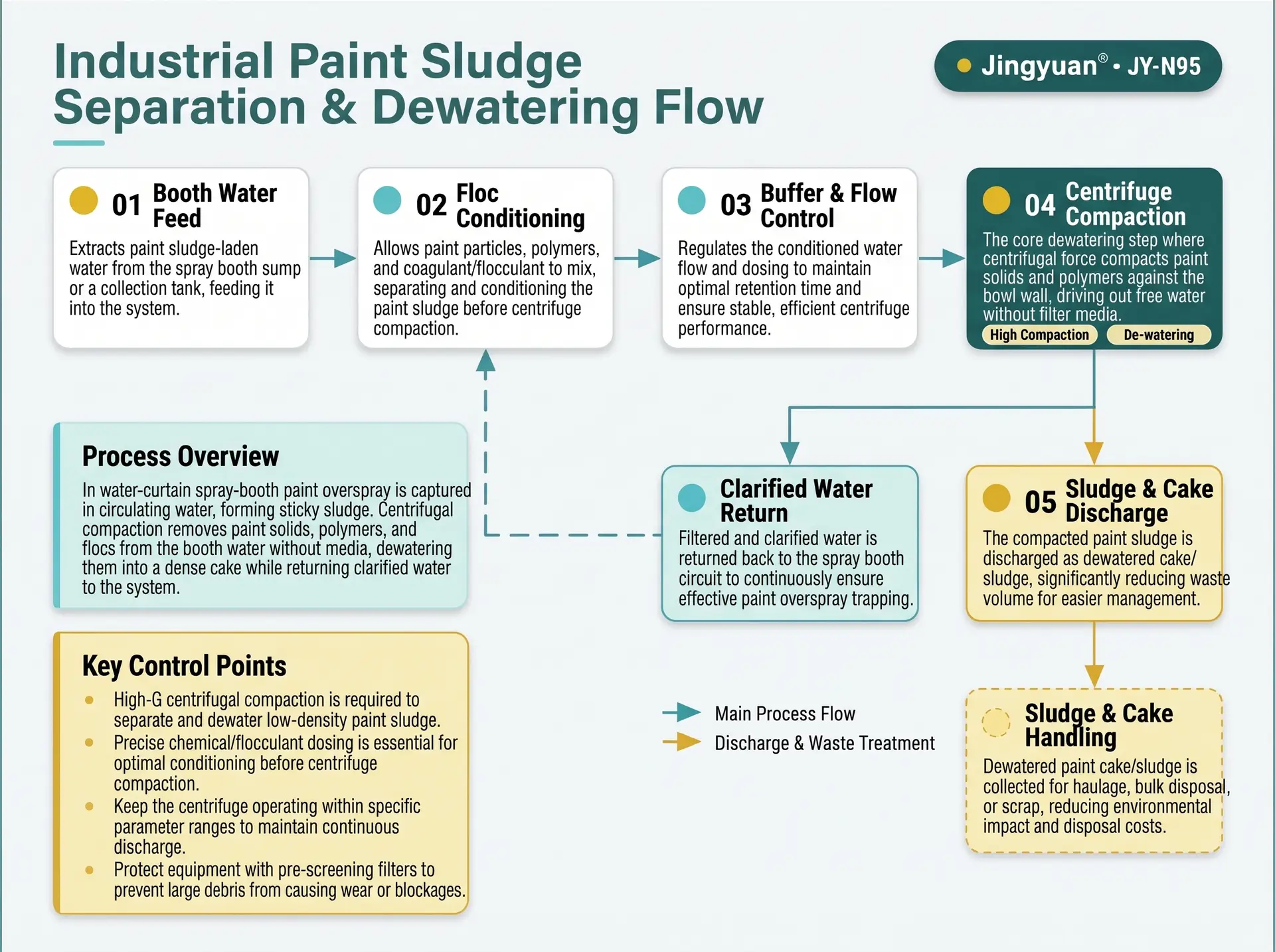
Swipe to see all steps.
- 1
Booth water feed
Sludge-laden water is drawn from the booth sump or a collection tank.
- 2
Floc conditioning
Where the paint system requires it, detackifier and floc condition are checked before separation.
- 3
Centrifugal compaction
Sludge is compacted against the bowl wall and free water is driven out.
- 4
Cake discharge
Compacted sludge is discharged for collection and disposal.
- 5
Water return
Clarified water returns to the booth circuit, reducing make-up and disposal volume.
Representative arrangement. Piping, buffer volume and control integration are confirmed per project.
Where the Volume Reduction Comes From
The benefit comes from how much water leaves the plant with the solids. It is measured on your own sludge, not quoted as a figure.
What changes in the mass balance
- The mass sent for disposal is set by the dry-solids mass and by how much water is still held in the sludge.
- A drier cake means less mass to be transported for the same paint solids.
- Pressed-out water stays in the booth circuit instead of leaving as waste.
What to measure
- Mass of sludge removed per week and its dry-solids fraction today.
- Mass of cake and its dry-solids fraction after separation, by the same method.
- Disposal cost per tonne and the number of transports.
No compaction percentage is published. The cake remains hazardous waste unless the paint chemistry and local rules say otherwise.
From Booth Sample to Machine Specification
Evaluation is a short, defined sequence. The same parameters are measured before and after so the result is a comparison on your own booth.
Before: establish the baseline
- Record paint type and consumption, detackifier programme and dosing, booth water volume and pH.
- Take a sludge sample and note whether it sinks, floats or stays dispersed; measure its dry-solids fraction.
- Note the sludge mass removed per week, disposal route and cost.
- Record cleaning shutdown frequency and duration, labour hours, and pump or nozzle fouling.
After: trend on your booth
- Measure cake mass and dry-solids fraction by the same method as the baseline.
- Follow clarity of the returned water, make-up water and sludge accumulation in the tank.
- Compare shutdown frequency, labour hours and transport count against the baseline.
- Judge the benefit from the trend on your booth, not from a general figure.
Where a bench or pilot test is needed, the conditions are agreed after the engineering review of your data.
Practical Notes for Running the Circuit
Floc conditioning
- Check detackifier dosing and floc condition before the separator.
- Limit shear in pumps and valves so flocs are not broken.
- Keep the condition consistent; changes in dosing change how the sludge compacts.
Solvent vapour and classified areas
- Solvent-borne booths can have flammable vapour near equipment.
- Area classification and any explosion-protection requirement are reviewed per project.
- Suitability of the standard configuration for a classified area is not assumed.
Cake and waste handling
- The cake is normally hazardous waste; classify it by analysis of the actual sludge and local regulation.
- Protect operators from chemical exposure and use suitable containers.
- Do not mix sludge from different paint systems before classification.
Water return and chemistry
- Clarified water returns to the booth; whether it needs further treatment depends on the paint system's water-quality requirement.
- Dissolved solvent and chemical oxygen demand are not removed by the separator.
- Level and chemistry make-up stay with the paint-system supplier's programme.
Symptoms and What to Check
Separation addresses the solids part of these problems. Each symptom also has chemistry and process causes that sit outside the separator.
| Symptom | Possible contributor | What to check |
|---|---|---|
| Cake is wetter than expected | Weak or broken flocs, or a dilute feed | Feed dry-solids fraction, floc condition, detackifier dosing, throughput |
| Sludge is not captured | Sludge lighter than water, or buoyant flocs | Whether the sludge sinks or floats, detackifier programme, skimming or flotation option |
| Returned water is cloudy | Fine pigment and filler, or broken flocs | Floc condition, shear in pumping, throughput |
| Pumps or nozzles foul and the water curtain is disturbed | Solids in circulation | Solids concentration, bypass flow, nozzle cleaning interval |
| Sludge hardens in the tank or piping | Reactive resin curing | Cleaning timing, tank sweep, paint-system data |
| Cleaning shutdowns continue | Sludge accumulates faster than it is removed | Sludge generation rate against bypass flow, draw-off location |
General guidance. Root cause is confirmed against your process data.
Confirmed Parameters — Not Marketing Figures
Values are drawn from the product parameter set used across this site. Nothing is restated or re-typed per application page.
| Flow rate | 25–120 L/min Depends on fluid properties and operating conditions — the maximum rate is not available for every medium. |
|---|---|
| Centrifugal acceleration | 2200 G An acceleration parameter — not a filtration precision. |
| Motor power | 4.0 kW |
| Power supply | 380 V, 50 Hz |
| pH range | 6–9 Applicability confirmed per fluid chemistry — not a universal compatibility statement. |
| Control system | PLC, fully automatic PLC brand options: SIEMENS / ABB / SCHNEIDER — optional configurations, confirmed per order. |
| Solids discharge | Automatic |
| Inlet connection | DN20 Standard configuration; confirm against order documentation. |
| Outlet connection | DN100 (4 in) Standard configuration; confirm against order documentation. |
| Operating design | Continuous 24-hour operation design Design intent; duty cycle and maintenance interval confirmed with the configuration. |
Check Whether Your Duty Fits the Range
The selection tool runs the same six checks our engineers run: flow range, fluid and material compatibility, settling behaviour, viscosity and temperature, pretreatment needs, and the resulting suitability class. Your industry is carried into the form automatically.
Run the selection check
The selection tool compares your flow rate, fluid chemistry and solids data against the confirmed operating range of the JY-N95 and returns one of four classifications. It does not promise separation efficiency.
Engineering Questions for This Application
How much does centrifugal compaction reduce sludge volume?
Will it work with water-borne and solvent-borne paints?
Does the machine remove solvents from the water?
What happens to the clarified water?
Is the cake still hazardous waste?
What is needed to evaluate a booth?
Does it handle floating paint sludge?
Is explosion protection available for solvent-borne booths?
Can it run on the booth circuit continuously?
How is the dry-solids content of the cake measured?
Does detackifier dosing change after separation is installed?
What pH can the booth water have?
Have a Fluid That Fits This Description?
Send the fluid type, solids loading and target — our engineers review the duty and confirm what has to be tested.