
Aluminium Extrusion & Metal Forming Oil Filtration
Extrusion presses and cold-heading machines contaminate their lubricants with fine aluminium, phosphate scale, iron wear particles and oil sludge. In viscous oil, filter media blind long before they are loaded. Centrifugal separation removes those solids without a medium — provided the density difference, viscosity and temperature are right.
This page covers one application direction in detail: where the contamination comes from, what the fluid and solids actually are, how centrifugal separation behaves in that context, and what has to be confirmed before a machine is specified.
In short
- Typical solids: fine aluminium, phosphate scale, iron wear particles and oil sludge — all removed by density difference, not by a filter medium.
- Viscosity and particle size, not the machine alone, decide how much of the fine fraction can be removed; both are evaluated before a machine is specified.
- The JY-N95 covers 25–120 L/min with 2200 G rated acceleration and automatic solids discharge; the working flow rate depends on the fluid.
- No recovery percentage or oil-life multiple is published here — results are confirmed on your fluid.
What Makes This Application Difficult
Where the contamination comes from
- Billet shear and die friction at elevated temperature release fine aluminium that stays suspended in the extrusion lubricant.
- Cold-heading, tapping and thread-rolling add phosphate scale, iron wear particles and oil sludge to the forming oil.
- Sludge settles in tanks and on heat-exchange surfaces, reducing cooling capacity and circulating contaminated oil.
Fluid characteristics
- Extrusion lubricants are viscous and heavily additised; viscosity rises further as solids and oxidation products accumulate.
- Cold-heading oils carry extreme-pressure additives that are sensitive to fine metal content and to water contamination.
Where conventional filtration falls short
- Viscous oil blinds filter paper and cartridges; differential pressure spikes and elements are changed far too often.
- Settling tanks need long residence times and large floor area, and still leave the fine fraction in circulation.
- Magnetic separators capture ferrous wear only, leaving aluminium and phosphate debris behind.
Effect on production
- Die-land pick-up produces scratches and roughness that remain visible after anodising, painting and electrophoresis.
- Fine aluminium acts as an abrasive between tool and workpiece and accelerates punch and die wear.
- Frequent media changeout interrupts production and generates oily waste that must be disposed of as hazardous material.
Solids, Fluid and Operating Conditions
Qualitative characterisation — the actual range for your process is established from fluid samples and operating data, not assumed from this table.
| Particle / solid | Density difference | Typical size | Solid concentration | Fluid viscosity | Temperature & chemistry |
|---|---|---|---|---|---|
| Aluminium fines | Moderate — noticeably denser than the oil | Micron to sub-millimetre | Load-dependent; rises with recycle | Medium to high (oil) | Amphoteric metal; reacts with strong alkali and acid |
| Phosphate scale and drawing soap residue | Moderate to high | Flake and fine particulate | High in cold-heading circuits | Medium to high (oil) | Alkaline residue; can emulsify water into oil |
| Iron wear particles and sludge | High | Fine to coarse | Rises with tool wear | Medium to high (oil) | Catalyses oil oxidation |
Density difference, size class and loading vary by process. Absolute values are confirmed during application evaluation.
Extrusion Lubricant vs Cold-Heading Oil
Both are viscous metal-working fluids, but they fail in different ways. Treating them as one application hides the data that actually matters at evaluation.
| Aspect | Aluminium extrusion lubricant | Cold-heading / forming oil |
|---|---|---|
| Dominant solids | Fine aluminium from billet shear and die friction, plus oil sludge | Phosphate scale and soap residue, iron wear particles, oil sludge |
| Separation behaviour | Smallest density difference against oil; the fine fraction is the limiting case | Heavier solids dominate; density difference is larger and separation is generally easier |
| Fluid | Viscous, heavily additised; viscosity rises with solids and oxidation products | Oil with extreme-pressure additives; sensitive to fine metal and to water |
| Water and chemistry | Confirm per circuit; check additive condition after cleaning | Alkaline phosphate residue can emulsify water into the oil; additive check is part of the trend |
| Data to collect first | Particle-size distribution of the fine fraction; viscosity against temperature | Solids loading; water content; additive level and acid number |
| Likely pre-treatment | Coarse screen; settling or pre-thickening where the fine fraction is high | Coarse screen; sludge and free-water draw-off |
Qualitative comparison. Fluid and solids data for your own circuit replace this table at evaluation.
How Centrifugal Separation Applies
Centrifugal separation uses the density difference between the solids and the oil. Aluminium is lighter than steel or carbide, so the density contrast against oil is smaller and settling is slower; residence time and viscosity therefore matter more than they do in carbide grinding. The JY-N95's rated 2200 G provides the driving force, and flow rate is set within the 25–120 L/min range to suit the fluid actually being processed.
Because no filter medium is involved, viscosity does not blind the machine — it only slows separation and increases drag on the particles. Higher-viscosity oils are therefore evaluated at a lower throughput, and temperature control (heating the oil to a defined viscosity) is a legitimate part of the process design rather than an optional extra.
The practical consequence is that three things are designed together: the throughput, the operating temperature and any pre-thickening step. The next section sets out how each one acts on settling.
- Aluminium has a comparatively small density difference against oil. Fine fractions may require reduced throughput, a settling or pre-thickening step, or both.
- No recovery percentage is published. Results are site-specific and depend on particle size, viscosity, temperature and solids loading.
- Water and dissolved contaminants are out of scope. Emulsified water requires dehydration, and additive chemistry must be managed separately.
What Governs Separation: Density, Size and Viscosity
Settling under centrifugal acceleration follows Stokes' law for ideal particles in laminar flow. It does not predict site results, but it shows which variable to look at first and which way each one pushes.
| Factor | Effect on settling speed | What it means for this application |
|---|---|---|
| Density difference | Settling is faster when the difference between solid and oil is larger | Against mineral oil, iron and phosphate debris have a substantially larger density difference than aluminium and separate more readily; aluminium fines are the limiting fraction. |
| Particle diameter | Settling slows sharply as particle diameter falls | Very fine aluminium may stay suspended; the achievable cut is established by test. |
| Oil viscosity | Settling is slower in more viscous oil | Reducing viscosity by controlled heating speeds separation. Temperature is limited by the lubricant supplier's limits and the flash point. |
| Acceleration | Higher acceleration increases settling speed | Set by the machine (2200 G rated). The operating levers are throughput and temperature. |
| Residence time | Longer residence gives more time to settle | Lower throughput increases residence time; heavy or fine-loaded oils are evaluated at the lower end of the 25–120 L/min range. |
Direction of effect only. Real oils, particle shapes and solids concentrations deviate from the ideal case; absolute values are confirmed on your fluid.
Where the Separator Sits in the Circuit
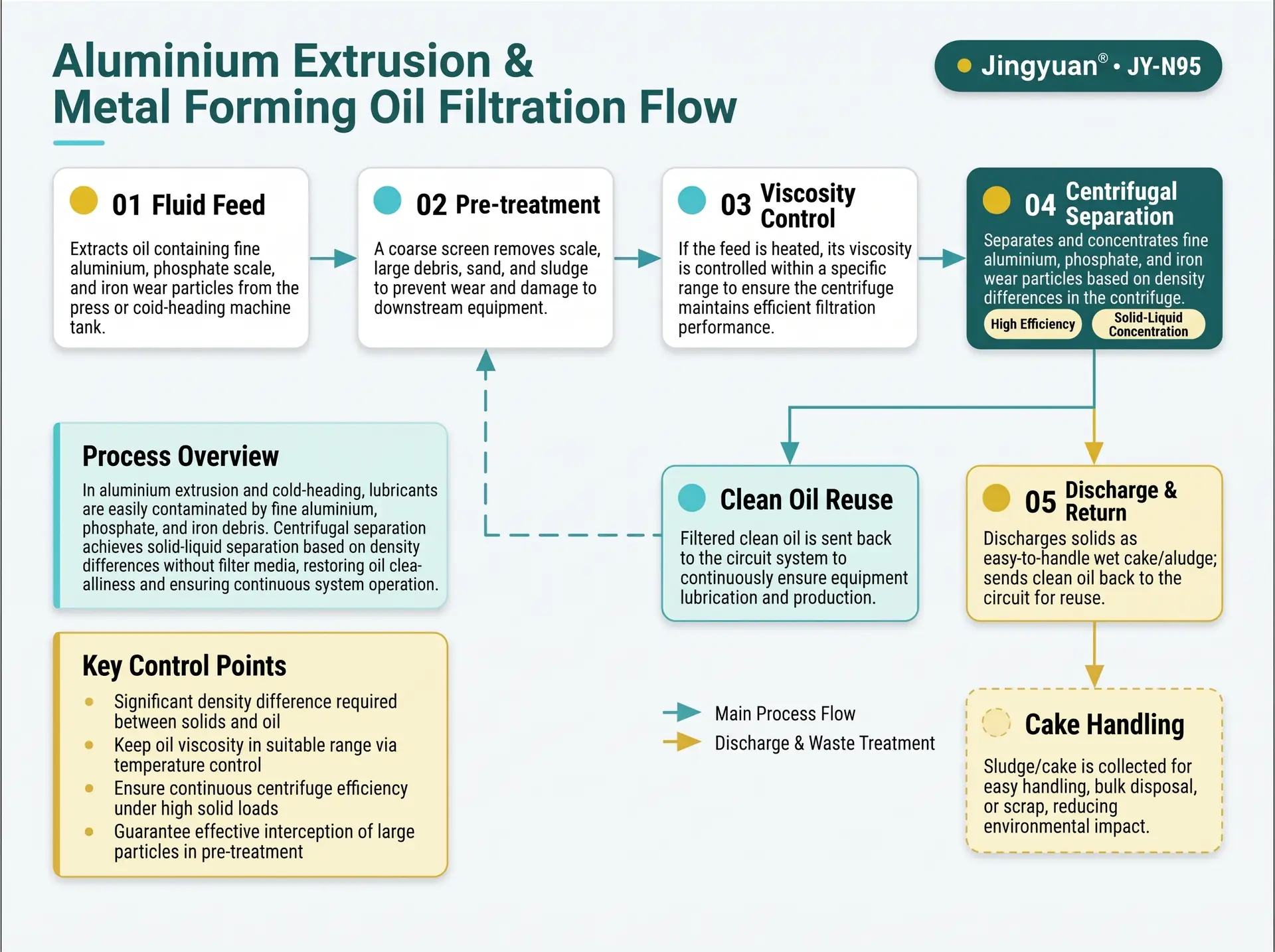
Swipe to see all steps.
- 1
Fluid feed
Oil is drawn from the press or heading-machine reservoir.
- 2
Pre-treatment
A coarse screen removes swarf and large flakes; water and sludge are drawn off where the circuit allows.
- 3
Viscosity control
Where required, the oil is held at a defined temperature so separation behaviour is repeatable.
- 4
Centrifugal separation
Aluminium, phosphate and iron solids are concentrated at the bowl wall.
- 5
Discharge and return
Solids leave as a low-moisture cake; clarified oil returns to the reservoir for reuse.
Representative arrangement. Piping, buffer volume and control integration are confirmed per project.
From Fluid Sample to Machine Specification
Evaluation is a short, defined sequence. The same parameters are measured before and after so the result is a comparison on your own circuit.
Before: establish the baseline
- Take a sample from the circulating line at operating temperature, not from the tank bottom.
- Record viscosity at operating temperature, solids content and particle-size distribution.
- Record water content, acid number and additive level where the oil supplier provides a reference.
- Note current filtration method, changeout frequency, tank sludge and the surface-quality reject rate.
After: trend in your circuit
- Repeat the same measurements at fixed intervals under the agreed throughput and temperature.
- Follow die-surface quality, tank and cooler sludge, and any downstream filter changeout frequency.
- Adjust throughput and temperature one variable at a time and keep the record.
- Use the trend, not a general life multiple, to judge the oil-life benefit.
Where a bench or pilot test is needed, the test conditions are agreed after the engineering review of your data.
Practical Notes for Running the Circuit
Temperature and viscosity control
- Hold the oil at a stable, defined temperature so separation behaviour is repeatable.
- Keep the setpoint within the lubricant supplier's limits and well below the flash point; avoid local overheating at the heater surface.
- Include the heat-up and hold time in the buffer-volume design.
Pre-treatment
- A coarse screen keeps swarf and large flakes out of the machine.
- Draw off free water and settled sludge upstream where the circuit allows.
- The separator is sized for fine solids in circulation, not for bulk sludge removal.
Handling the discharged cake
- The cake is oil-wetted and low in moisture; handle it as oily industrial solid waste under local regulations.
- Keep it oil-wetted in storage and avoid creating dry dust during handling.
- Confirm the waste classification and disposal route with the local authority or waste contractor.
Monitoring
- Trend solids content, viscosity, acid number and additive level in the circulating oil.
- Watch die-surface quality, tank sludge and downstream filter pressure drop.
- Discharge settings and maintenance intervals are confirmed with the configuration at commissioning.
Symptoms and What to Check
Separation addresses the solids part of these problems. Each symptom also has process causes that sit outside the separator.
| Symptom | Possible contributor | What to check |
|---|---|---|
| Die-land pick-up or scratches persist | Fine aluminium recirculating; die temperature; lubricant selection | Fine fraction in the circulating oil, die temperature, lubricant grade, throughput setting |
| Sludge in tanks or on coolers | Accumulated sludge and oxidation products | Pre-treatment, tank cleaning schedule, solids loading, oil temperature |
| Downstream filter pressure drop rises quickly | High fine-solids load or high viscosity | Upstream solids content, oil temperature, separator throughput |
| Oil darkens or acid number rises | Oxidation catalysed by iron fines and heat | Iron content, operating temperature, oil change interval |
| Oil is not clear after separation | Throughput too high for the viscosity and size; emulsified water | Reduce throughput, confirm temperature, measure water content |
| Punch or die wear increases | Abrasive fines in the forming oil | Solids content and particle size in the forming oil |
General guidance. Root cause is confirmed against your process data.
Confirmed Parameters — Not Marketing Figures
Values are drawn from the product parameter set used across this site. Nothing is restated or re-typed per application page.
| Flow rate | 25–120 L/min Depends on fluid properties and operating conditions — the maximum rate is not available for every medium. |
|---|---|
| Centrifugal acceleration | 2200 G An acceleration parameter — not a filtration precision. |
| Motor power | 4.0 kW |
| Power supply | 380 V, 50 Hz |
| pH range | 6–9 Applicability confirmed per fluid chemistry — not a universal compatibility statement. |
| Control system | PLC, fully automatic PLC brand options: SIEMENS / ABB / SCHNEIDER — optional configurations, confirmed per order. |
| Solids discharge | Automatic |
| Inlet connection | DN20 Standard configuration; confirm against order documentation. |
| Outlet connection | DN100 (4 in) Standard configuration; confirm against order documentation. |
| Operating design | Continuous 24-hour operation design Design intent; duty cycle and maintenance interval confirmed with the configuration. |
Check Whether Your Duty Fits the Range
The selection tool runs the same six checks our engineers run: flow range, fluid and material compatibility, settling behaviour, viscosity and temperature, pretreatment needs, and the resulting suitability class. Your industry is carried into the form automatically.
Run the selection check
The selection tool compares your flow rate, fluid chemistry and solids data against the confirmed operating range of the JY-N95 and returns one of four classifications. It does not promise separation efficiency.
Engineering Questions for This Application
Can a centrifugal separator clean viscous extrusion oil?
Does it remove aluminium as effectively as steel particles?
Will separation stop die pick-up?
What happens to water in the oil?
How is the oil-life benefit established?
What information is needed for an evaluation?
Does the oil have to be heated before separation?
Is the separator a replacement for the coarse screen or settling tank?
How should the separated solids be handled?
How can I tell whether the separator is working in my circuit?
Does it remove additives or change the oil chemistry?
Can one machine serve both an extrusion press and a cold-heading line?
Have a Fluid That Fits This Description?
Send the fluid type, solids loading and target — our engineers review the duty and confirm what has to be tested.