Cleaning & Surface Treatment Bath Purification
Cleaning and pretreatment baths load up with oil, detached particles and sludge. When the bath is dumped early, the cost is chemistry, water, energy and downtime. A bypass centrifugal separator keeps removing those solids while the bath stays in service.
This page covers one application direction in detail: where the contamination comes from, what the fluid and solids actually are, how centrifugal separation behaves in that context, and what has to be confirmed before a machine is specified.
In short
- Typical loads: metal fines, scale, phosphate and conversion-coating sludge, and oil — removed in a bypass stream while the bath keeps working.
- Fit is set by chemistry first: the JY-N95's confirmed pH range is 6–9, so strongly alkaline and acidic baths are reviewed individually.
- The JY-N95 covers 25–120 L/min with 2200 G rated acceleration and automatic solids discharge; the working flow rate depends on the fluid.
- No bath-life multiple or efficiency figure is published. Dissolved chemistry stays under the bath owner's control.
What Makes This Application Difficult
Where the contamination comes from
- Cleaning and phosphating baths accumulate oil, detached metal particles, scale and sludge from the parts passing through.
- Oil films on the bath surface reduce cleaning effectiveness and can re-deposit on parts.
- Sludge settles on heating surfaces and in tanks, reducing heat transfer and effective volume.
Fluid characteristics
- Baths are formulated alkaline, neutral or acidic, with surfactants, builders and inhibitors; pH and chemistry constrain the materials of construction.
- Temperature is often elevated, which changes viscosity and the behaviour of oil and solids.
Where conventional filtration falls short
- Filter bags and cartridges consume media and need frequent replacement, particularly when oil is present.
- Skimming removes free oil but not the suspended and settled solids.
- Dumping and remaking the bath is the default answer — expensive in chemistry, water, energy and lost production time.
Effect on production
- Contaminated baths clean poorly, so reject rates rise downstream.
- Oil carry-over contaminates rinse stages and the following process steps.
- Frequent dumping increases water consumption, effluent load and chemical cost.
Solids, Fluid and Operating Conditions
Qualitative characterisation — the actual range for your process is established from fluid samples and operating data, not assumed from this table.
| Particle / solid | Density difference | Typical size | Solid concentration | Fluid viscosity | Temperature & chemistry |
|---|---|---|---|---|---|
| Metal particles and fines | High | Micron to millimetre | Production-rate dependent | Water-like | Reactive in acidic baths |
| Tramp oil and grease | Low — floats | Free oil and emulsified droplets | Continuous carry-in | Varies with temperature | Surfactant-dependent emulsification |
| Phosphate and conversion-coating sludge | Moderate to high | Flocculated fine solid | Rises with throughput | Water-like | Acidic; scale-forming |
Density difference, size class and loading vary by process. Absolute values are confirmed during application evaluation.
Which Baths Fit the Standard Range
Cleaning and pretreatment lines contain very different chemistries. The first question is the bath pH, because the JY-N95's confirmed range is 6–9.
| Aspect | Neutral and mildly alkaline cleaning baths | Strongly alkaline or acidic baths (degreasing, pickling, phosphating) | Rinse stages |
|---|---|---|---|
| Typical load | Oil, detached particles, surfactant-bound soil, sludge | Metal fines, scale, conversion-coating sludge, oil | Carry-over solids and oil from the bath before |
| Fit to the confirmed pH 6–9 | Within the standard range; confirm surfactant package and temperature | Outside the standard range; engineering review of materials is required and compatibility is not assumed | Depends on the carry-over; pH of the rinse water is confirmed per line |
| Separator role | Bypass removal of suspended solids; free oil with an upstream skimmer or coalescer where needed | Only after the materials review; the sludge duty is the same in principle | Bypass circulation to hold solids down |
| Stays with the bath owner | pH, surfactant concentration, dissolved contamination | Acid and alkalinity control, dissolved metals, bath make-up | Make-up and drag-out control |
| Data to collect first | Chemistry, pH, temperature, volume, solids and oil load, dump criteria | Full bath specification and wetted-material requirements before any evaluation | Line layout, carry-over, rinse volume |
Qualitative comparison. Fit is confirmed per bath; the pH range is the confirmed standard-configuration range, not a universal compatibility statement.
How Centrifugal Separation Applies
In a bypass arrangement a fraction of the bath is continuously drawn off, passed through the separator and returned. Dense particles and sludge are concentrated at the bowl wall under the JY-N95's rated 2200 G and discharged automatically, so the bath is cleaned without being taken out of service. Because no filter medium is used, oil-wetted solids do not blind the machine the way they blind bags and cartridges.
The limit is chemistry rather than mechanics. Bath pH, temperature and surfactant package determine which materials of construction are acceptable and how oil behaves; where free oil dominates the load, a coalescing or skimming step is usually combined with the separator. Three-phase behaviour (oil, water, solids) is evaluated per bath, never assumed.
Fit is decided in this order: bath chemistry and pH, then the solids and oil load, then bypass flow and temperature. The next section sets out how those variables act on settling.
- Separators remove solids and, in suitable arrangements, free oil. Dissolved chemistry, surfactant concentration and bath pH are managed by the bath owner.
- The JY-N95's confirmed pH range is 6–9. Baths outside it, including strongly alkaline cleaners and acidic phosphating baths, need an engineering review of the materials of construction before a machine is specified.
- Bath-life extension depends on drag-in rate, dump criteria and the rest of the bath maintenance programme; no multiple is published as a confirmed figure.
What Governs Separation in a Bath
Settling under centrifugal acceleration follows Stokes' law for ideal particles in laminar flow. It does not predict site results, but it shows which variable to look at first.
| Factor | Effect on settling speed | What it means for this application |
|---|---|---|
| Density difference | Settling is faster when the difference between solid and fluid is larger | Metal fines have a large density contrast against a water-based bath and separate readily. Flocculated phosphate sludge is closer to the bath density and separates more slowly. |
| Particle diameter | Settling slows sharply as particle or floc size falls | Large flocs settle well; fine or sheared flocs settle more slowly. Pumping and shear can break flocs, so the circuit is designed to limit it. |
| Fluid viscosity | Settling is slower in more viscous fluid | Baths are water-like, which favours separation; temperature lowers viscosity further. |
| Free and emulsified oil | Lighter than the bath, so it moves opposite to the solids | Free oil is handled by a skimmer or coalescer; emulsified oil depends on the surfactant package. |
| Acceleration and residence time | Higher acceleration increases settling speed; lower throughput gives longer residence | Acceleration is set by the machine (2200 G rated); the operating levers are bypass flow and temperature. |
Direction of effect only. Real baths, flocs and loadings deviate from the ideal case; absolute values are confirmed on your fluid.
Where the Separator Sits in the Circuit
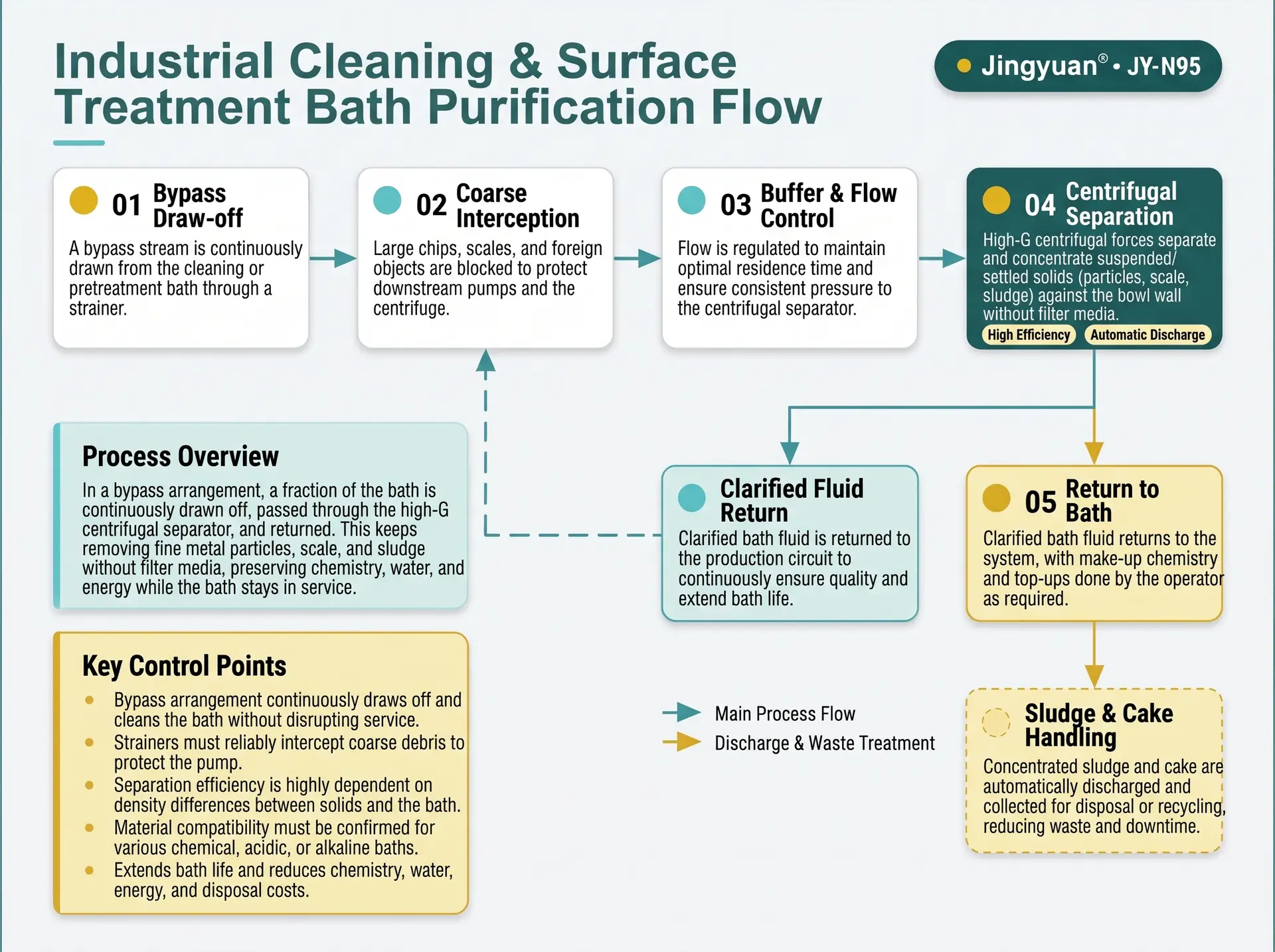
Swipe to see all steps.
- 1
Bypass draw-off
A side stream is taken from the bath through a strainer.
- 2
Coarse interception
Large chips and foreign objects are retained before the pump.
- 3
Centrifugal separation
Suspended and settled solids are concentrated at the bowl wall.
- 4
Automatic discharge
Concentrated sludge leaves as a compact cake.
- 5
Return to bath
Clarified bath fluid returns, with level and chemistry made up by the operator.
Representative arrangement. Piping, buffer volume and control integration are confirmed per project.
Sizing the Bypass Stream
In a bypass arrangement the separator cleans a fraction of the bath at a time. What matters is bath volume, solids load and how often the bath is dumped.
Bath turnover considerations
- Bypass flow is sized from bath volume, solids load, the dump criteria and the circulation pattern of the line.
- The JY-N95 covers 25–120 L/min; the working flow depends on the fluid and conditions, and the maximum is not available for every medium.
- A larger bath or a higher solids load calls for a larger side stream or a longer circulation period; the arrangement is confirmed by evaluation rather than from a general turnover figure.
Arrangement points
- Choose a draw-off point that represents the circulating bath rather than a dead zone or the settled sludge layer.
- Return the cleaned fluid away from the draw-off and below the liquid surface to limit air entrainment and foaming.
- Buffer volume, piping and control integration are confirmed per project.
From Bath Sample to Machine Specification
Evaluation is a short, defined sequence. The same parameters are measured before and after so the result is a comparison on your own bath.
Before: establish the baseline
- Record the bath specification, pH, temperature, volume and the wetted materials of the circuit.
- Take the routine bath control analysis defined by the chemical supplier, plus suspended solids and oil content.
- Note the sludge accumulation rate, heater or heat-exchanger fouling interval, and the dump frequency and its stated reasons.
- Record chemical, water and energy consumption and the downstream reject rate.
After: trend in your bath
- Repeat the same measurements at fixed intervals under the agreed bypass flow.
- Follow sludge accumulation, heater fouling, oil carry-over into rinse stages and reject rate.
- Compare dump frequency and make-up consumption against the baseline.
- Judge the benefit from the trend in your bath, not from a general multiple.
Where a bench or pilot test is needed, the conditions are agreed after the engineering review of your data.
Practical Notes for Running the Circuit
Oil management
- Where free oil dominates, combine the separator with a skimmer or coalescer upstream.
- Emulsified oil depends on the surfactant package and is evaluated per bath.
- The separator removes solids; oil and chemistry remain part of the bath programme.
Hot baths and materials
- Bath temperature is part of the evaluation data; hot-fluid handling and personnel protection are reviewed per project.
- Confirm wetted materials and seals against the full bath chemistry, including surfactants and inhibitors.
- Stay within the confirmed pH range, or complete the materials review first.
Foam and air entrainment
- Keep the suction line submerged and the return below the liquid surface.
- Check the bath level so the pump does not draw air.
- Surfactant baths foam readily when air is entrained.
Handling the discharged sludge
- The cake can contain metals, phosphate and oil, and may be classed as hazardous or controlled waste depending on composition.
- Classify the sludge by analysis and local regulation before choosing the disposal route.
- Make up level and chemistry after separation; the separator does not replenish the bath.
Symptoms and What to Check
Separation addresses the solids part of these problems. Each symptom also has chemistry and process causes that sit outside the separator.
| Symptom | Possible contributor | What to check |
|---|---|---|
| Parts clean poorly | Oil film, depleted chemistry or suspended solids | Bath control analysis against the supplier's limits, oil on the surface, suspended solids |
| Sludge builds up on heaters or in the tank | Settled solids and scale | Draw-off location, bypass flow, descaling interval, solids load |
| Oil carries into rinse stages | Free or emulsified oil | Skimmer or coalescer, surfactant package, bath temperature |
| Bath foams | Air entrainment with a surfactant package | Suction and return arrangement, bath level, pump condition |
| Frequent dumping despite the bypass | Dump criteria driven by dissolved contamination or chemistry | Dump criteria, drag-in rate, dissolved metals and chemistry control |
| Rejects stay high with a clean bath | Cause lies in rinse, drying or an upstream step | Rinse quality, drying, upstream process steps |
General guidance. Root cause is confirmed against your process data.
Confirmed Parameters — Not Marketing Figures
Values are drawn from the product parameter set used across this site. Nothing is restated or re-typed per application page.
| Flow rate | 25–120 L/min Depends on fluid properties and operating conditions — the maximum rate is not available for every medium. |
|---|---|
| Centrifugal acceleration | 2200 G An acceleration parameter — not a filtration precision. |
| Motor power | 4.0 kW |
| Power supply | 380 V, 50 Hz |
| pH range | 6–9 Applicability confirmed per fluid chemistry — not a universal compatibility statement. |
| Control system | PLC, fully automatic PLC brand options: SIEMENS / ABB / SCHNEIDER — optional configurations, confirmed per order. |
| Solids discharge | Automatic |
| Inlet connection | DN20 Standard configuration; confirm against order documentation. |
| Outlet connection | DN100 (4 in) Standard configuration; confirm against order documentation. |
| Operating design | Continuous 24-hour operation design Design intent; duty cycle and maintenance interval confirmed with the configuration. |
Check Whether Your Duty Fits the Range
The selection tool runs the same six checks our engineers run: flow range, fluid and material compatibility, settling behaviour, viscosity and temperature, pretreatment needs, and the resulting suitability class. Your industry is carried into the form automatically.
Run the selection check
The selection tool compares your flow rate, fluid chemistry and solids data against the confirmed operating range of the JY-N95 and returns one of four classifications. It does not promise separation efficiency.
Engineering Questions for This Application
Can the separator run while the bath is in service?
Does it remove oil as well as solids?
Is it compatible with acidic phosphating baths?
Can it extend bath life?
What about rinse stages?
What data is needed for evaluation?
Can it be used on strongly alkaline degreasing baths?
What bypass flow does a bath need?
Can it handle hot baths?
Should free oil be skimmed before the separator?
Does it remove dissolved metals or bath chemistry?
Is the separated sludge hazardous waste?
Have a Fluid That Fits This Description?
Send the fluid type, solids loading and target — our engineers review the duty and confirm what has to be tested.