
How Centrifugal Separation Works
Centrifugal separation is a physical separation process driven by rotation. This page explains the principle, what the JY-N95's 2200 G parameter does and does not mean, and the operating conditions that determine real-world results.
Density-Driven Separation in a Rotating Field
When a liquid mixture rotates, every component experiences a centrifugal field. Components with different density, particle size and settling behaviour respond differently to that field. Under suitable conditions, denser solid particles migrate outward and concentrate, while the liquid phase remains closer to the axis of rotation — which is what makes solid-liquid separation possible.
What 2200 G Means — and What It Does Not
- Fc
- centrifugal force acting on the particle
- m
- particle mass
- ω
- angular velocity of the rotation
- r
- rotation radius at the particle's position
- 2200 G is the centrifugal acceleration parameter provided for the JY-N95.
- G is an acceleration unit, not a filtration precision — it says nothing directly about the smallest particle the machine can separate.
- Actual separation results depend on particle density and size, liquid viscosity, flow rate and the internal geometry of the machine.
JY-N95 Working Principle Diagram
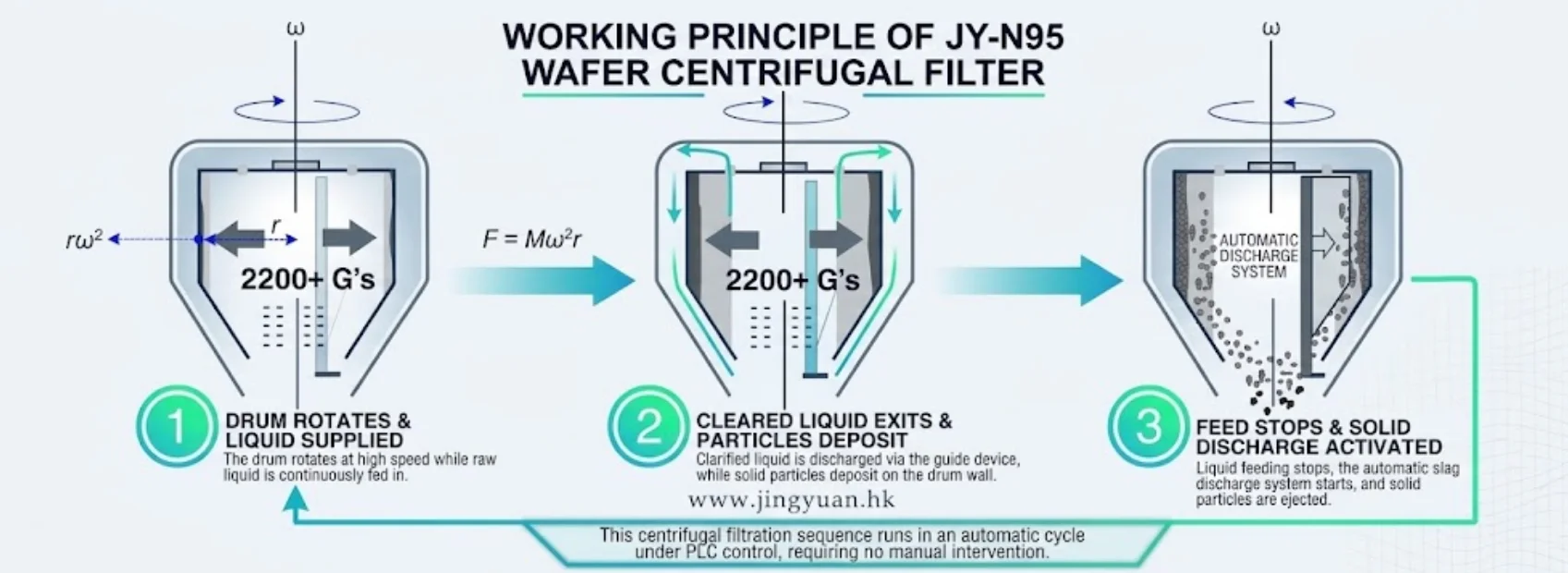
Fully Automatic Operating Sequence

Swipe to see all steps.
Centrifugal Separation vs. Membrane Filtration
Centrifugal separation and membrane filtration are different separation mechanisms. Centrifugal separation uses density differences under a centrifugal field. Membrane filtration relies on the membrane material and its pore structure. The two are not interchangeable, and filtration parameters such as nominal pore size or beta ratios must not be applied to a centrifugal separator — or the other way round.
What Determines Separation Performance
Density difference
A meaningful density difference between the solid and liquid phases is the physical basis of centrifugal separation. A difference of about 0.1 g/cm³ or more is the practical starting point; below that the settling rate falls away sharply.
Particle size and density
Larger and denser particles respond more strongly to the centrifugal field. At 2,200 G, solids in the single-digit micron range and above settle within one pass — this is the range where a separator outperforms filter media on running cost. Solids below roughly one micron need flocculant-assisted pre-treatment or a polishing stage.
Liquid viscosity
Higher viscosity slows particle migration and affects achievable flow rate.
Flow rate
The 25–120 L/min range is fluid-dependent; residence time in the field changes with flow.
Solids loading
Higher solids loading affects discharge frequency and handling. The machine accepts roughly 1–50 % suspended solids by weight; the discharge cycle is set to the load.
Machine geometry
Internal geometry determines the actual field and flow path — confirmed with the machine configuration.
JY-N95 Working Principle Video
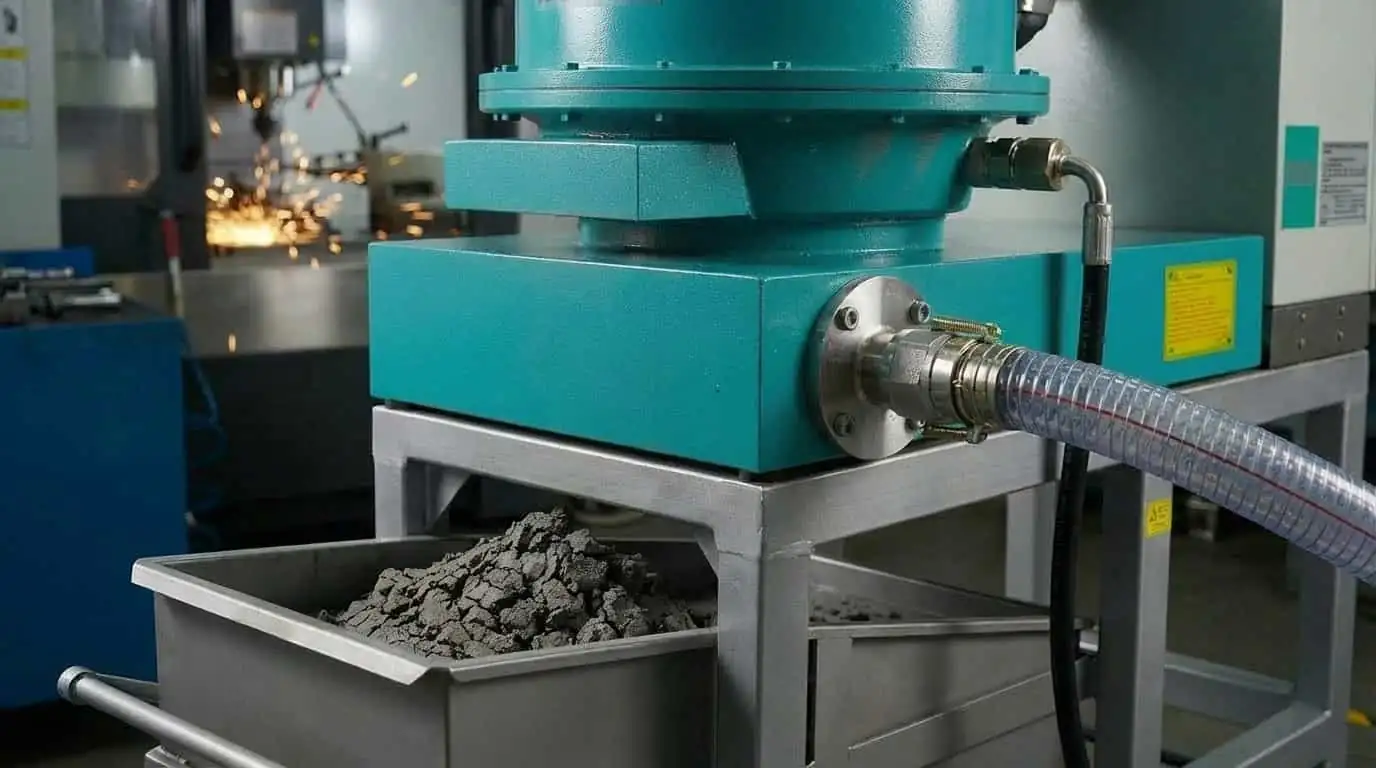
The video shows the JY-N95 automatic centrifugal separator in operation. It is placed on this page because the working principle is the natural context for understanding the machine.
Video source: Jingyuan's published product video on YouTube. The player loads only after the visitor presses play.
Evaluate Your Application
Tell us your fluid, contaminants and target — our team maps the principle to your process conditions.