
Centrifugal Separation vs. Conventional Filtration: What Should You Compare?
Centrifugal separation and conventional filtration solve different problems, so “which is better?” is the wrong question. The useful comparison is about your fluid, your solids and your operating pattern.
Two mechanisms, two sets of strengths
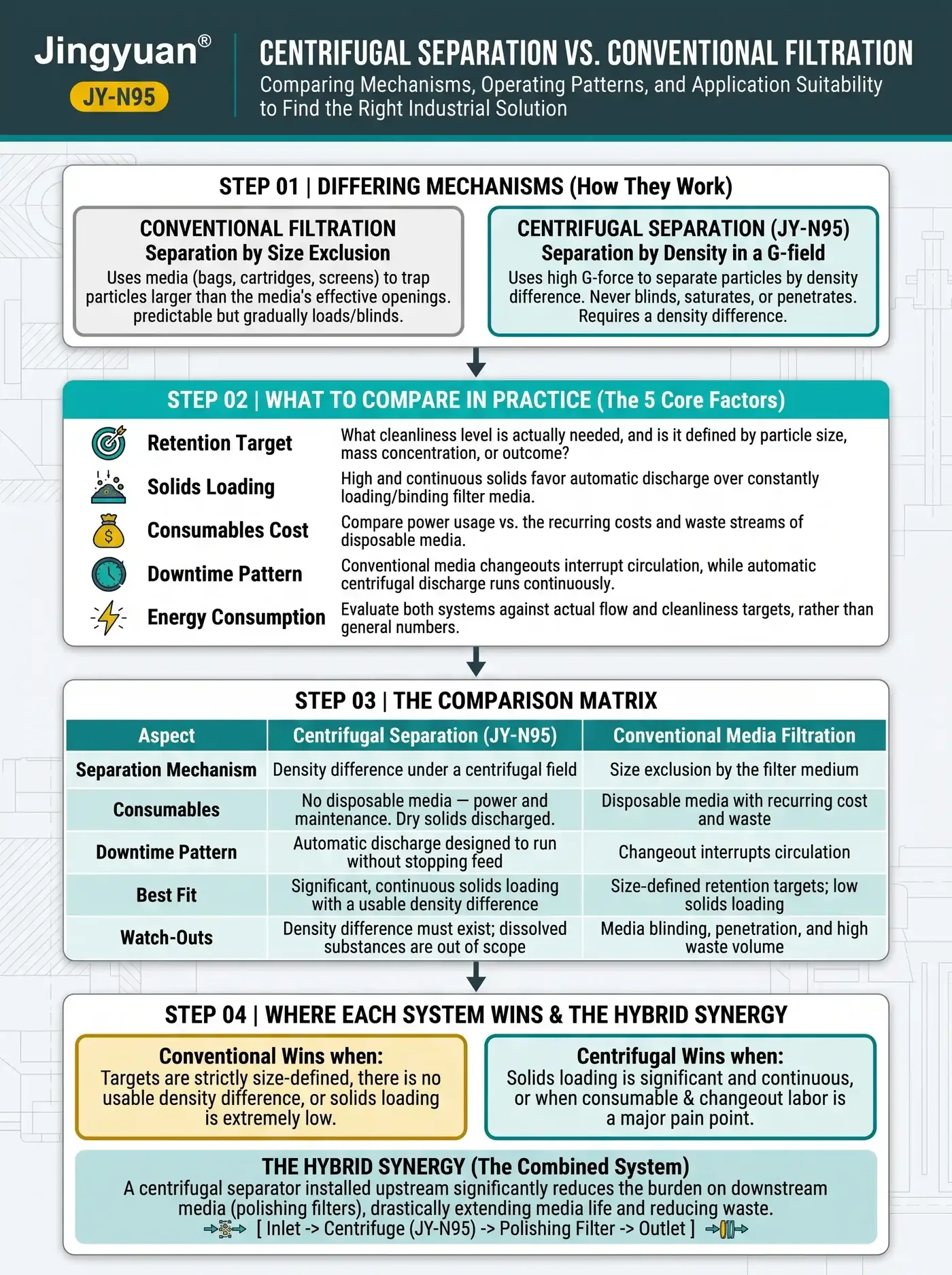
Conventional filtration (bags, cartridges, screens) separates by size exclusion. Particles larger than the media's effective openings are retained, and the media gradually loads up. It is a mature, well-understood process with predictable retention behaviour for a given medium.
Centrifugal separation separates by density in a centrifugal field. It does not rely on media pores, so it does not blind, saturate or let particles penetrate in the same way. The trade-off is that it needs a density difference between solid and liquid to work with.
What to compare in practice
| Factor | Conventional filtration | Centrifugal separation |
|---|---|---|
| Retention target | Well suited when cleanliness is defined by particle size | Well suited when the goal is removing dense solids by mass; depends on density difference |
| Solids loading | Media loads up; high continuous loading means frequent changeouts | High, continuous solids favour automatic discharge instead of loading a medium |
| Consumables | Disposable media bring a recurring cost and a recurring waste stream | Consumes power and generates collected solids; reduces media dependence but does not remove all consumables |
| Downtime pattern | Media changeouts interrupt circulation | Automatic discharge is designed to run without stopping the feed |
| Energy | Consumes energy | Consumes energy |
Energy deserves a caution: both approaches use it, so compare at your actual flow rate and cleanliness target, not at headline numbers.
Before comparing, decide how you define “clean enough”: by particle size, by mass concentration, or by a process outcome (tool life, surface finish, fluid service interval). The answer often points to the right technology.
Where each one still wins
Conventional filtration is the right choice when:
- the target is defined by particle size,
- the fluid has no usable density difference, or
- solids loading is so low that media changeouts are rare.
Centrifugal separation earns its place when:
- solids loading is significant and continuous,
- media consumption or changeout labour is the pain point, and
- the fluid's density difference supports the process.
Most real installations combine both. A centrifugal separator upstream reduces the burden on downstream media, and polishing filters downstream catch what a density-driven step was never designed to remove.
The honest summary
Neither technology is universally superior. Compare mechanism against your fluid and solids, consumables against your operating pattern, and downtime against your production schedule. That is exactly the checklist our application evaluation walks through with you.
Related pages
Questions About Your Application?
Our engineering team reviews fluid and process data and discusses suitability with you.