
Evaluate Centrifugal Separators for Grinding Fluids
Buying a separator without fluid data is guesswork. This checklist turns “can it handle my grinding fluid?” into a set of answerable questions, the same ones our engineering team asks first.
Short on time? For a first evaluation, send us three things: your fluid type, what the solids are and roughly how fast they accumulate, and your required flow rate. We can start from there and tell you what else is worth measuring.
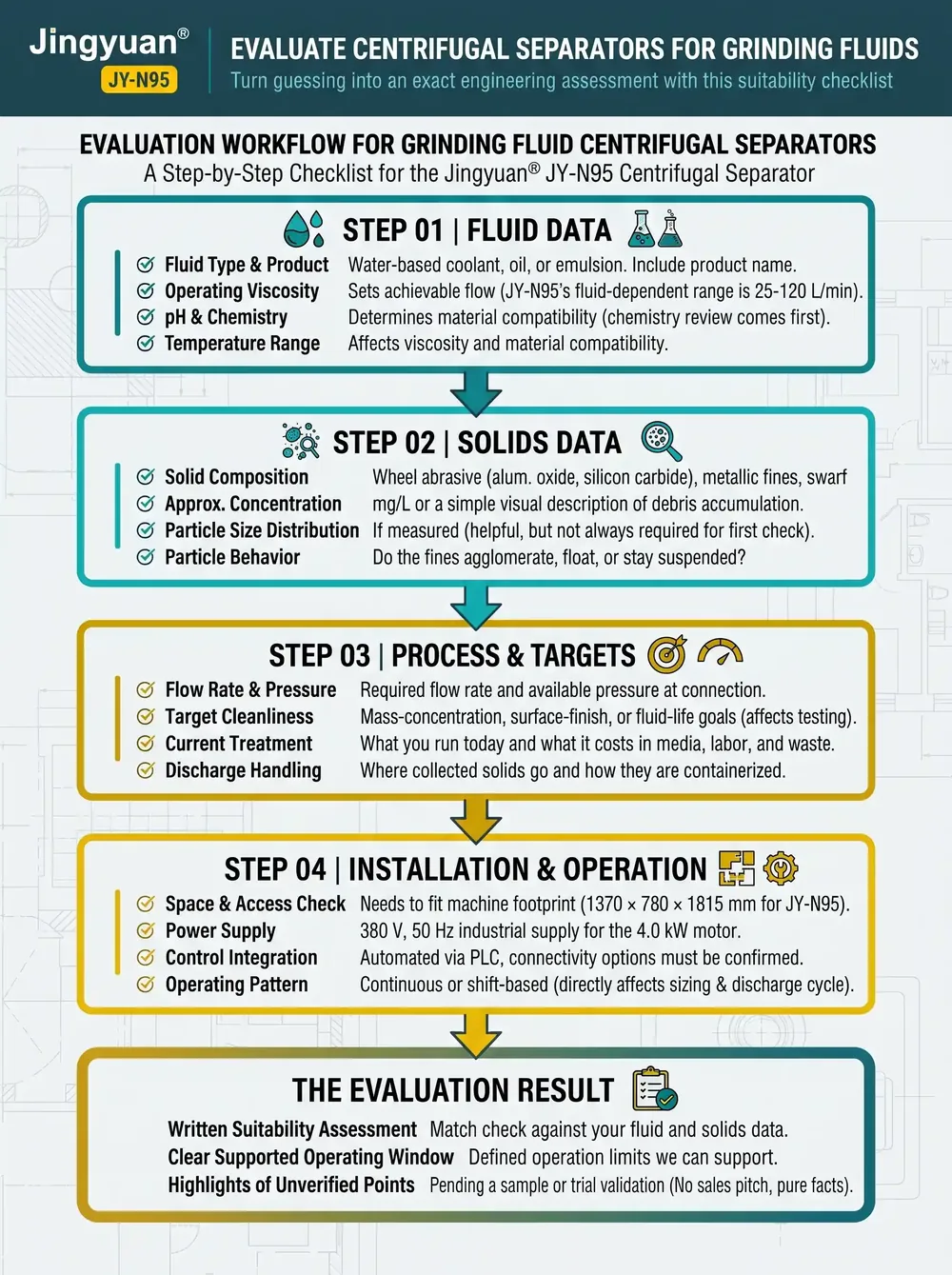
1. Fluid data
| Item | What to provide | Why it matters |
|---|---|---|
| Fluid type and product | Water-based coolant, oil or emulsion, plus the product name if you have it | Determines chemistry review and whether the fluid is a good fit for density-driven separation |
| Viscosity at operating temperature | Value or datasheet reference | Sets the achievable flow. The JY-N95's 25–120 L/min range is fluid-dependent |
| pH and chemistry | pH range and any additives | The applicable pH range is pending final confirmation for your fluid, so chemistry review comes first |
| Temperature range | Normal and peak operating temperature | Affects both viscosity and material compatibility |
2. Solids data
| Item | What to provide | Why it matters |
|---|---|---|
| What the solids are | Wheel abrasive (aluminium oxide, silicon carbide), metallic fines, swarf | Density and hardness both matter |
| Approximate concentration | mg/L, or a simple visual description of how fast debris accumulates | Drives how often the machine discharges |
| Particle size distribution | Only if already measured | Helpful but not always needed for a first evaluation |
| Behaviour | Do fines agglomerate, float or stay suspended? | Reveals whether the particles will actually migrate in a centrifugal field |
3. Process and targets
| Item | What to provide | Why it matters |
|---|---|---|
| Flow and pressure | Required flow rate and available pressure at the connection point | Defines the duty the machine must meet |
| Target cleanliness | A mass-concentration target, a surface-finish requirement or a fluid-life extension goal | Each implies a different acceptance test |
| Current treatment | What you run today and what it costs in media, labour and waste | Gives a baseline to compare against |
| Discharge handling | Where collected solids go and how they are containerised | Collected solids must be handled downstream |
4. Installation and operation
| Item | JY-N95 reference | What to check |
|---|---|---|
| Footprint | 1370 × 780 × 1815 mm overall | Space and access around the machine |
| Power supply | 4.0 kW motor, 380 V, 50 Hz industrial supply | Availability at the installation point |
| Control | PLC controls the machine automatically | Connectivity options are confirmed per configuration |
| Operating pattern | Continuous or shift-based | Affects both sizing and the discharge cycle |
What a good evaluation gives you
- A written suitability assessment against your fluid and solids data
- The operating window we can support
- The points that remain unverified until a sample or trial confirms them
Anything less is a sales pitch, not an evaluation.
Ready to start? Send us your fluid type, solids description and flow requirement, and we will tell you what we can confirm and what needs a sample or trial.
Related pages
Questions About Your Application?
Our engineering team reviews fluid and process data and discusses suitability with you.