
How Centrifugal Separation Works for Industrial Fluids
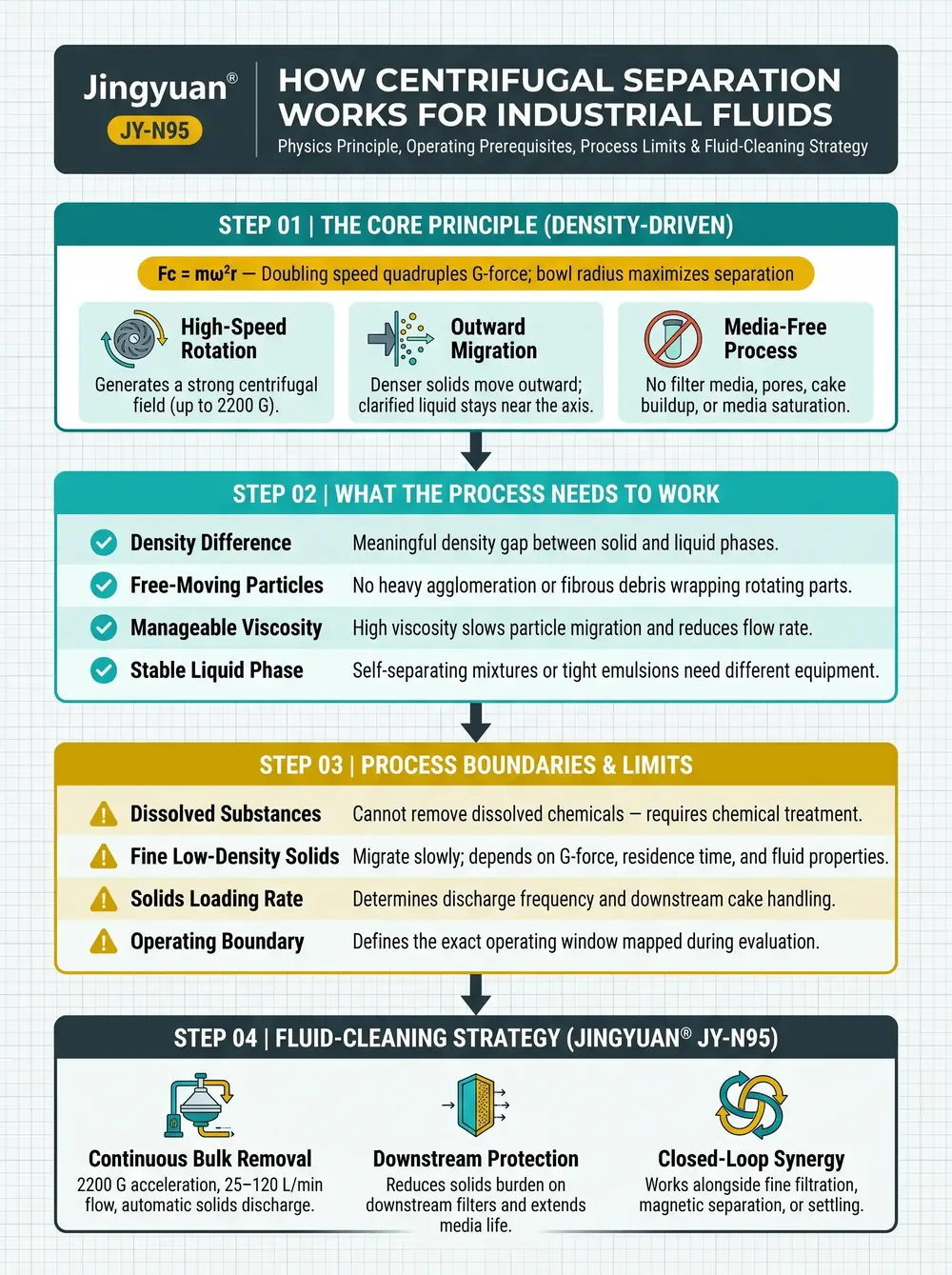
Centrifugal separation removes solid particles from a liquid by spinning the fluid so that denser material is thrown outward and the clarified liquid stays near the axis. The physics is simple. The practical value comes from knowing where it works well, where it does not, and what to check before specifying a machine.
The principle in brief
In a rotating liquid, particles denser than the fluid migrate outward under centrifugal force, given by Fc = mω²r (particle mass × angular velocity squared × radius). Two consequences follow:
- Speed matters most. Doubling the rotational speed quadruples the centrifugal field.
- Radius matters too. A larger bowl radius raises the field at the wall, and the farthest-travelling particles are the ones it helps most.
How fast a particle settles also depends on three things: the size of the particle, the density difference between particle and liquid, and the liquid's viscosity. Larger, denser particles in thinner liquid settle faster. Small, light particles in thick fluid settle slowly.
The process is density-driven. It needs no filter medium, so it does not depend on pores, cake formation or media saturation.
What the process needs to work
- A meaningful density difference. If solid and liquid have nearly the same density, the field has nothing to act on.
- Particles that are free to move. Heavy agglomerates or fibre-like contamination that wraps around rotating parts behave differently and should be evaluated first.
- A viscosity the field can overcome. High-viscosity fluids slow particle migration and reduce the flow rate you can achieve.
- A liquid phase that stays stable. Stable emulsions must be broken first or handled with different equipment.
Where the limits are
- Dissolved substances cannot be removed. They need chemistry or another process.
- Very fine, low-density particles migrate slowly. The result you can achieve depends on the actual field, residence time and fluid properties.
- Solids loading sets the duty cycle. It determines how often the machine discharges and how much collected material you must handle downstream.
None of these limits are defects. They mark the boundary of the process, and an application evaluation exists to map exactly that boundary for your fluid.
How it fits into a fluid-cleaning strategy
Centrifugal separation is usually one step in a wider fluid-management strategy. Placed upstream, it reduces the solids load reaching downstream filters, extends media changeout intervals and keeps recirculated fluid cleaner for longer. Conventional filtration, magnetic separation or settling may still have a role elsewhere in the loop.
The JY-N95 is Jingyuan's automatic centrifugal separator for industrial process fluids. It is rated at 2200 G centrifugal acceleration, with a fluid-dependent flow range of 25–120 L/min and automatic solids discharge.
Related pages
Questions About Your Application?
Our engineering team reviews fluid and process data and discusses suitability with you.